
The conversation about Artificial Intelligence within organizations has taken a clear turn. A couple of years ago, most companies were in testing mode—pilots, experiments with small teams, and almost artisanal use cases—but today the landscape is completely different. OpenAI's "The State of Enterprise AI 2025" report makes this abundantly clear: by 2025, AI will no longer be a promising novelty, but an operational layer that is beginning to take hold in the daily operations of businesses.
The most obvious sign is the acceleration of usage. OpenAI observes that activity on ChatGPT Enterprise has multiplied significantly in the last year. It's not just that more people are joining; those who join are actually using it, more intensively, and with objectives increasingly tied to real work. At the same time, organizations are consuming many more advanced models via APIs, which usually indicates something very specific: that AI has moved beyond the confines of a chat window and has begun to be integrated into internal products, processes, and systems. Simply put: AI is evolving from a standalone tool to becoming infrastructure.
And when a technology becomes infrastructure, the change isn't incremental, it's cultural. This is where one of the most interesting elements of the report comes in: the explosive growth of Custom GPTs and Projects. In practice, this means that companies are creating "specialized versions" of AI for repeatable tasks with their own context: one GPT for internal support, another for marketing operations, another for accelerating sales proposals, and another connected to technical expertise. It's not just about convenience. It's about starting to package processes as reusable assets. When know-how becomes a GPT, it ceases to depend on the "hero user" and becomes a team capability.
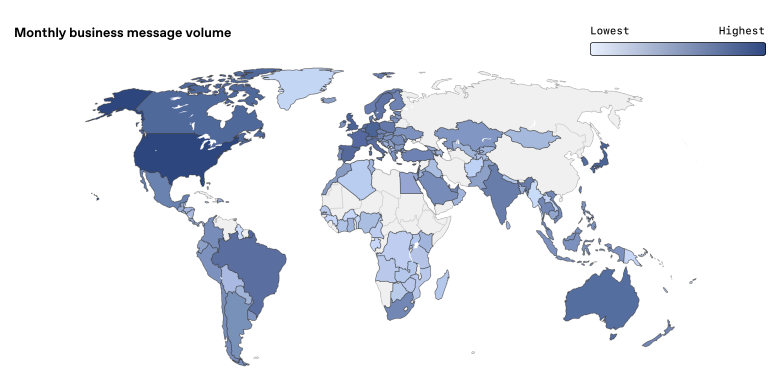
Geographically, the report indicates that enterprise AI adoption is no longer a US-centric phenomenon. While the US was the initial driver, international growth has accelerated significantly in the last six months. Among major markets, Australia, Brazil, the Netherlands, and France are the fastest growing paying customer base, with year-over-year growth exceeding 143%. This is key because it confirms that the "second wave" of scaling is coming from outside the US, driven by organizations moving from exploring to seriously deploying AI.
The value is also becoming measurable. The majority of employees surveyed by OpenAI report that AI improves the speed or quality of their work. In terms of time, the daily savings are no longer marginal: we're talking about almost an hour per day per active user, and considerably more for intensive users. AI is removing friction from tasks that previously consumed energy without adding any added value: summarizing information, preparing materials, generating drafts, debugging code, analyzing data, structuring plans, writing communications, and so on.
But there's another equally significant effect: the scope of what people can do is expanding. AI not only accelerates what you were already doing, but it also allows you to do things that were previously impossible due to a lack of time, skills, or specialized support. And when this happens at an organizational scale, a new competitive advantage emerges.
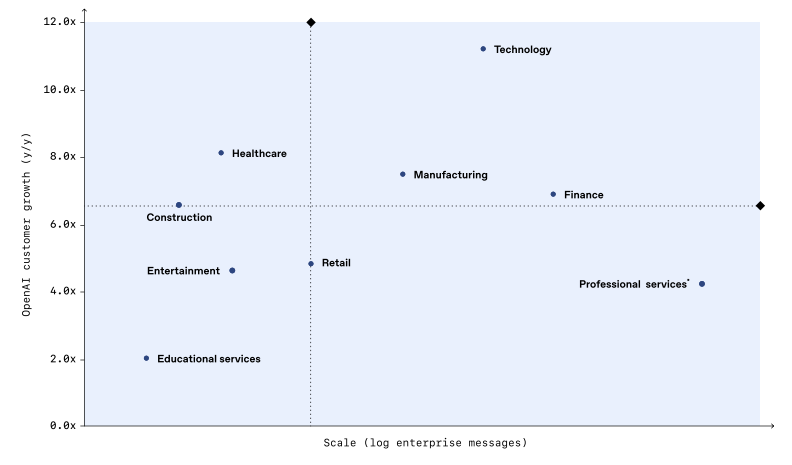
However, the report also offers an uncomfortable warning. The gap between leading and lagging companies is widening rapidly. Advanced users within companies use AI several times more than the average employee, and leading organizations derive more value per license than the average company. Why? Not because they have "better AI," but because they have better managed adoption: training, user guides, governance, process redesign, integration with data and systems, and a clear internal narrative of its purpose and expectations. By 2025, the obstacle will not be technological; it will be organizational.
Looking ahead, OpenAI anticipates that the next frontier won't simply be "smarter models" in the abstract. The big wave is coming in three directions: greater performance in specific business tasks, a greater capacity to understand the company's real-world context, and a paradigm shift toward agents that execute complete workflows.
For marketing, sales, and customer operations—areas where BOND LABS is deeply involved—this has direct implications. In marketing, AI is advancing from content generation to the automation of entire operations. In sales, co-pilots no longer just write emails; they analyze accounts, prepare for meetings, generate stronger proposals, and feed the CRM with useful information in near real-time. In customer experience, agents with context improve resolution, route cases more effectively, and increase satisfaction without bloating structures.
The report's final message is clear: 2025 was the year for serious deployment. Companies that remain stuck in endless pilot programs will fall behind. Those that industrialize use cases, build reusable assets, connect AI to their data and processes, and manage adoption as a cultural shift will have a significant advantage.
At BOND LABS, we've been helping people cross that bridge for some time now: from isolated testing to organizational capacity. If you want to understand what all this means in your context, prioritize where the real return is, and build an AI roadmap that moves the needle, we're ready to do it with you.