
Marketing has changed more in the last decade than in the previous hundred years. The reasons are multiple: new channels, real-time data, hyperconnected consumers, but they all converge on a single point: technology has become the language of growth. However, most companies still manage that technology as if it were an accessory, not a pillar.
That's where the concept of Marketing Technology, or simply MarTech, comes in. To talk about MarTech is to talk about the digital infrastructure that makes modern marketing possible. It's not just about software: it's the union of strategy, data, processes, and technology. In other words, it's what allows a brand to stop "doing marketing" and start operating with business precision.
What Marketing Technology really is
The term MarTech (an acronym for Marketing Technology) describes the set of tools, platforms, and systems that allow an organization to plan, execute, analyze, and optimize all of its marketing activities.
In its most basic form, a MarTech stack typically includes:
- A CRM (Customer Relationship Management) to manage customers and opportunities.
- Automation platforms that coordinate campaigns and communications across different channels.
- Content management systems (CMS/DXP) to control the digital experience.
- Data platforms (CDP, DMP, data warehouse) where customer information is consolidated.
- Analytical and personalization tools that translate data into business decisions.
What's truly important is how these pieces integrate to build a knowledge and decision-making system. A good stack isn't one that has the most tools, but one that transforms data into measurable actions.
Today, the most advanced companies understand MarTech as their digital nervous system: a network that captures signals (data), processes information (artificial intelligence), and executes responses (automated actions) with the same purpose as any biological system: adapting to survive and grow.
A bit of history: from the "stack" to the "nervous system"
The origins of modern MarTech date back to 2011, when Scott Brinker first published the Marketing Technology Landscape, a graphic featuring 150 logos. Twelve years later, that same map includes more than 15,000 active solutions. A 10,000% growth in just a decade.
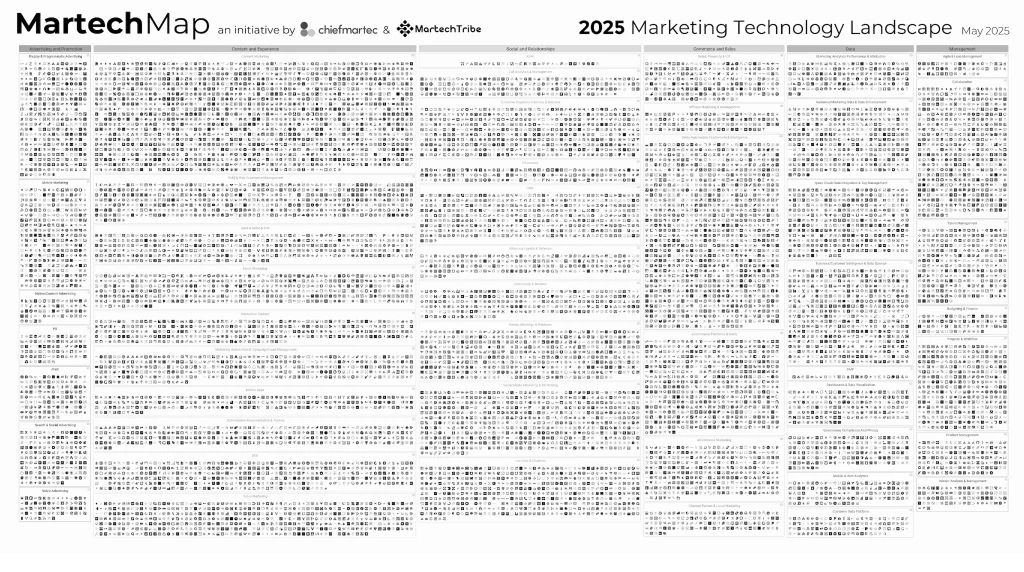
What once seemed like a fad became a truly global industry. However, in 2015, with the popularization of software as a service (SaaS), brands began to accumulate platforms, giving rise to the problem of fragmentation. Marketing departments found themselves trapped between dozens of platforms that didn't talk to each other. Thus, the term "Frankenstack" was born: complex, expensive, and difficult-to-maintain technological ecosystems.
The new era: data, intelligence and speed
The State of Martech 2025 summarizes this inflection point well: 56% of companies have already integrated their stack with a cloud data warehouse or lakehouse, and nearly 60% are using artificial intelligence on top of that data layer.
This means that MarTech has moved from being an execution system to a knowledge system. Instead of "using tools to do marketing," companies are now designing intelligent ecosystems that learn, recommend, and act based on data.
The key concept is the integration between three layers:
- Knowledge systems: where the data lives (CRM, CDP, warehouse).
- Context systems: where interaction with the customer takes place (CMS, DXP, MAP).
- The intelligence layer: made up of AI, decision models and automation, which connect the previous two.
The leap is not only technical, but also cultural. For the first time, marketing is moving from being based on intuition to becoming a science applied to customer relations.
Why MarTech should be the cornerstone of your business strategy
The impact of MarTech goes far beyond operational efficiency. When implemented with a business perspective, it becomes a structural pillar of growth.
- Accelerate revenue. A well-connected ecosystem improves the entire sales funnel: it identifies audiences more precisely, optimizes conversion, and enables cross-selling and upselling strategies based on real data.
- Reduce costs. Intelligent automation replaces manual tasks, eliminates redundancies, and improves coordination between marketing, sales, and customer service.
- Multiply relevance. Thanks to Customer Data Platforms (CDPs) and warehouse-native architectures, it's possible to build a unified view of the customer.
- Strengthens governance. In a regulatory and privacy context, a well-designed system enables seamless consent management, traceability, and information flows.
- Promotes continuous learning. Modern MarTech turns every action into a measurable experiment.
In short, MarTech translates technological complexity into a direct impact on the bottom line.
The emergence of AI: agents, decisions and autonomy
The artificial intelligence revolution has changed the game. The traditional platform-based model has given way to an ecosystem of intelligent agents operating between systems and users, capable of performing complex tasks without human intervention.
At the same time, reinforcement learning (RL) models are beginning to govern decision-making. Unlike static algorithms, these systems learn through trial and error, continuously optimizing results. This is the natural evolution from rules-based marketing to marketing based on autonomous decisions.
From "more" to "better": the end of the Frankenstack
The dominant trend is no longer to have "everything in one place," but rather to build composable systems, where each piece serves a clear function within a larger architecture. The role of MarTech consultants and architects is becoming essential: selecting, integrating, and orchestrating platforms with a strategic, not a technological, vision.
The goal isn't to accumulate, but to orchestrate. It's not about how many tools you use, but how they talk to each other.
How to Get Started: A Realistic Action Plan
The path to an efficient stack is approached methodically. At BOND LABS, we use a three-stage approach that prioritizes simplicity and business impact:
- Diagnostics and strategy: Analyze digital maturity, available data, and business objectives. Quick wins are identified, and a solid business case is defined.
- Architecture and design: Build a target architecture that prioritizes centralizing data, connecting the activation layer in a modular way, incorporating an AI layer, and ensuring a governance model.
- Implementation and training: Move forward in phases, activating the use cases with the highest ROI first. And, crucially, train the team.
The success of a MarTech stack doesn't depend on the tool itself, but on people's ability to operate it wisely.
Conclusion: Technology with a purpose
MarTech isn't an end, it's a means. A means to connect strategy with execution, vision with data, and ultimately, brand with its customer.
Technology alone doesn't transform businesses. What transforms is the way organizations understand and apply it. That's why at BOND LABS, we work with a simple conviction: less complexity, more impact.
The future of marketing belongs to those who master this balance. To those who know how to build strong bonds between technology, creativity, and business. And, above all, to those who understand that the true value of MarTech lies not in the tool, but in the connection it creates.